How to Price Your Items to Sell Faster in Nigeria
May 18 2026
5 minutes READ

Ejoh Esther
385
You have an item to sell. You post it online. Then you wait.
Days pass. Weeks pass. Nothing.
You drop the price. Still nothing. You drop it again. Finally, someone buys.
But by then, you have wasted weeks of time and left money on the table.
Here is the truth that separates successful sellers from frustrated ones: pricing is everything.
Price too high, and your item will sit for months while buyers scroll past. Price too low, and you leave cash on the table that could have been yours.
The perfect price is the one that sells your item fast without making you feel like you gave it away.
This guide will teach you exactly how to find that price every single time. Let us get into it.
Why Most Sellers Get Pricing Wrong
Before we talk about how to price correctly, let us understand why so many sellers get it wrong.
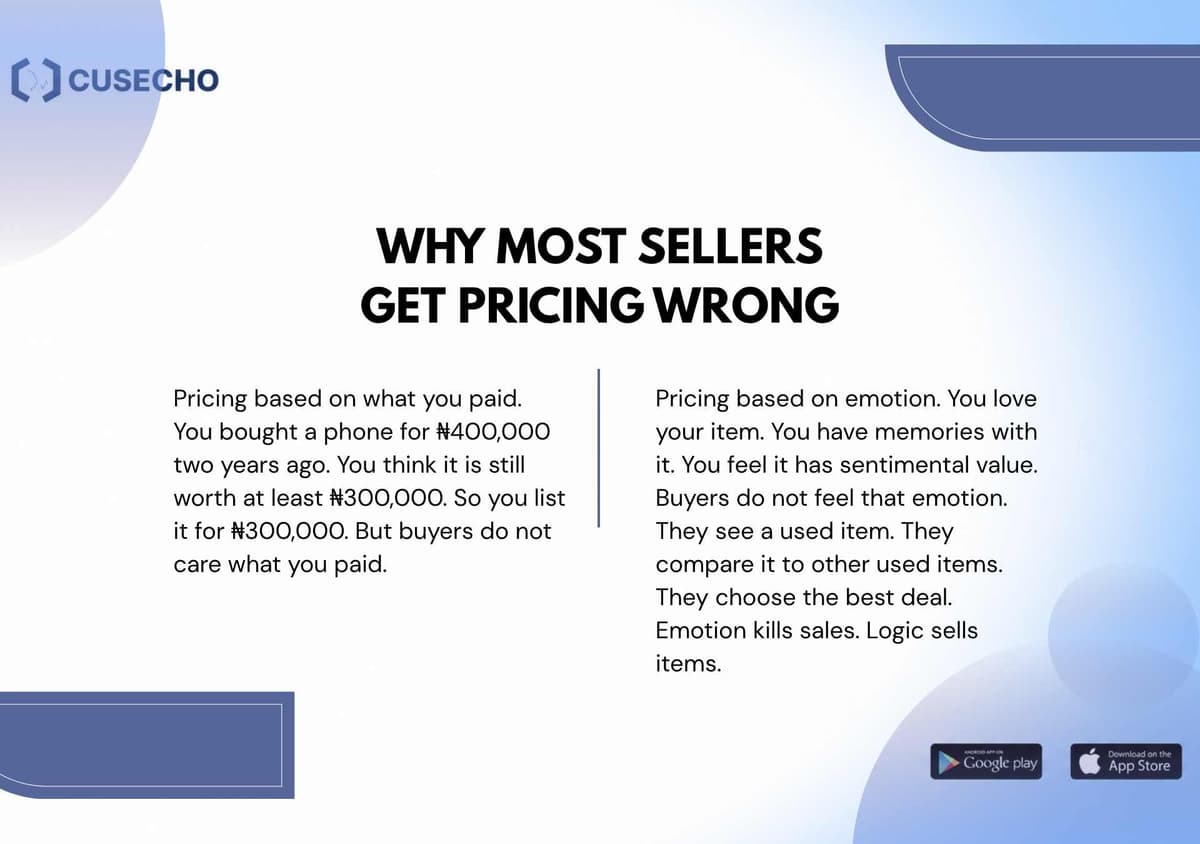
Pricing based on what you paid. You bought a phone for ₦400,000 two years ago. You think it is still worth at least ₦300,000. So you list it for ₦300,000. But buyers do not care what you paid. They care what the item is worth today. What you paid is irrelevant. What the market will pay today is all that matters.
Pricing based on emotion. You love your item. You have memories with it. You feel it has sentimental value. Buyers do not feel that emotion. They see a used item. They compare it to other used items. They choose the best deal. Emotion kills sales. Logic sells items.
Not researching the market. You guess a price. You post it. You hope. That is not a strategy. That is gambling. Successful sellers research before they list. They know what similar items are selling for. They price with data, not feelings.
Refusing to negotiate. You set a firm price. A buyer offers slightly less. You say no. They walk away. The item sits for another month. In Nigerian markets, negotiation is expected. The right strategy is to price slightly above your minimum and leave room for negotiation.
The Psychology of Nigerian Buyers
Understanding how buyers think will help you price smarter.
Buyers want a bargain. Nigerian buyers love to feel they have gotten a good deal. Even if your price is fair, they will still try to negotiate. That is not an insult. It is culture. If you price at ₦100,000 and refuse to move, many buyers will walk away – not because ₦100,000 is unfair, but because they did not get to "win" the negotiation. The solution is simple: price at ₦110,000 and accept ₦100,000. The buyer feels they won. You get the price you wanted. Everyone is happy.
Buyers compare everything. Before a buyer messages you, they have probably looked at ten other listings. They know what similar items are selling for. If your price is even slightly higher, they will buy from someone else. You need to know your competition and price at or slightly below the average market price.
Buyers are impatient. If your item does not sell in the first week, many buyers will assume something is wrong with it. "Why has no one bought this?" they think. "Maybe there is a problem." Price to sell in the first seven to ten days. A fast sale signals a good deal. A slow sale signals a problem.

Step-by-Step Guide to Pricing Your Items
Follow these steps every time you list an item. They will save you weeks of waiting and thousands of naira in lost value.
Step 1: Research What Similar Items Are Selling For
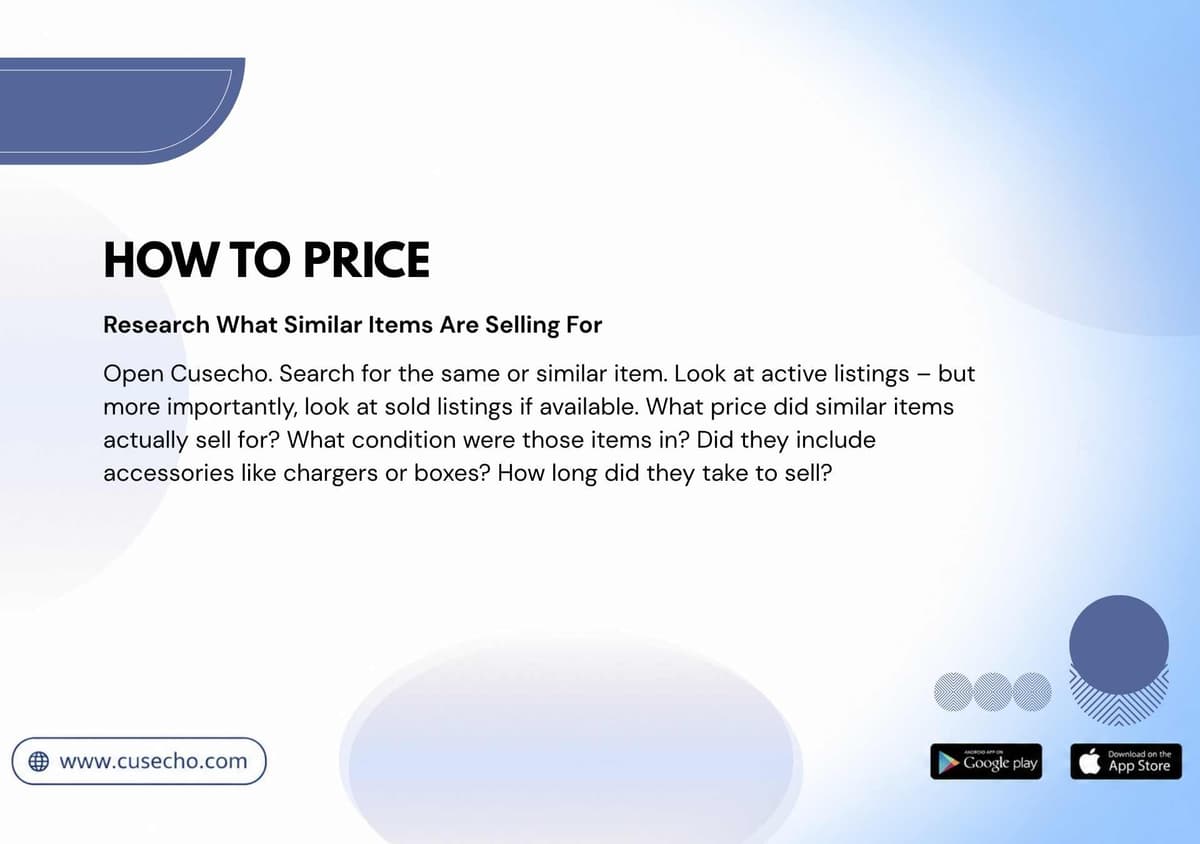
Do not guess. Do not rely on memory. Go look. Open Cusecho. Search for the same or similar item. Look at active listings – but more importantly, look at sold listings if available. What price did similar items actually sell for? What condition were those items in? Did they include accessories like chargers or boxes? How long did they take to sell?
This research takes ten minutes. It can save you weeks of waiting.
Step 2: Calculate Fair Depreciation
Used items lose value. Here is a rough guide.
A flagship phone like an iPhone or Samsung typically retains about sixty to seventy percent of its new value after one year, dropping to forty to fifty percent after two years. A mid-range phone holds about fifty to sixty percent after one year and thirty to forty percent after two years.
Laptops follow a similar pattern – fifty to sixty percent after one year, thirty to forty percent after two years. Sneakers that have been worn usually sell for forty to sixty percent of their new price. Designer bags hold value better, often fifty to seventy percent after one year.
Televisions and refrigerators typically sell for fifty to sixty percent of their new price after one year. Furniture holds similar value.
These are estimates. Condition, brand, and demand affect actual prices. But this gives you a starting point.
Step 3: Adjust for Condition
Not all used items are equal. Adjust your price based on condition.
An item that is like new – used once or twice with no scratches – can sell for seventy to eighty percent of the new price. A gently used item with minor wear but fully functional sells for fifty to seventy percent. An item in fair condition with visible wear but still fully functional sells for thirty to fifty percent. An item that needs repair or is not fully functional sells for ten to thirty percent.
Be honest about condition. Overpricing a damaged item will lead to wasted time and frustrated buyers.
Step 4: Factor in Accessories
Does your item come with extras? These add value.
The original box adds about five to ten percent in value. The original charger adds another five to ten percent. Original earphones add about five percent. A receipt or proof of purchase adds about five percent. An extra screen protector or case adds about five percent.
If you have all of these, you can price at the higher end of your range.
Step 5: Price for Negotiation
Remember: Nigerian buyers love to negotiate. Build that into your price.
The formula is simple. List your item at your minimum acceptable price plus ten to fifteen percent. For example, if you want ₦100,000 minimum, list at ₦110,000 to ₦115,000. When the buyer offers ₦100,000, you accept. They feel they won. You get what you wanted.
Step 6: Use the "Odd Price" Effect
There is a psychological quirk in pricing. ₦99,500 feels significantly cheaper than ₦100,000 – even though the difference is only ₦500.
Use this to your advantage. Instead of ₦100,000, try ₦99,500. Instead of ₦150,000, try ₦149,000. Instead of ₦50,000, try ₦49,500. Instead of ₦200,000, try ₦199,000.
It sounds small. But it works.
Step 7: Test and Adjust
Your first price is not set in stone. If your item does not sell in seven to ten days, it is probably too high.
Drop the price by five to ten percent. Relist with fresh photos if possible. See what happens. Sometimes a small price drop is all it takes to trigger a sale.
Common Pricing Mistakes to Avoid
Pricing based on what you paid. Buyers do not care what you paid. They care about today's value.
Refusing to negotiate. You will lose sales to sellers who are willing to talk.
Pricing too high to "test the market." You will waste weeks while buyers ignore your listing.
Pricing too low out of fear. You leave money on the table.
Not researching competition. You have no idea what a fair price is.
Keeping the same price for months. Stale listings signal that something is wrong.
How Cusecho Helps You Price Perfectly
Cusecho gives you tools that make pricing easier and faster.
See what similar items sold for. Cusecho shows you active and completed listings. You can see real prices that real buyers paid. No guessing.
Reach more buyers. When you list on Cusecho, your items automatically cross-post to Adzone. More eyes on your item means faster sales – even at fair prices.
Free vendor training. Cusecho offers free training that includes pricing strategies. Learn from successful sellers who have mastered the art of pricing.
Build a reputation. As you sell more items on Cusecho and earn positive reviews, buyers trust you more. Trusted sellers can often price slightly higher because buyers know they are reliable.
Escrow protection. When you sell on Cusecho, buyers pay into escrow before you ship. You do not need to price low to compensate for trust issues. The platform handles trust for you.
How to Know When Your Price Is Right
You will know your price is right when three things happen.
First, you receive messages within the first few days. Interest means your price is in the right range. Silence means it is too high.
Second, buyers make reasonable offers. Lowball offers – like ₦50,000 for a ₦200,000 item – mean your price is attracting the wrong crowd or your listing is unclear. Serious offers mean serious buyers.
Third, your item sells within one to two weeks. That is the sweet spot for most used items. Faster than that, you might have priced too low. Slower than that, you might have priced too high.
See more related